

Ragù: The Long Simmer
maybe the ultimate winter comfort meal?

Thank you SO MUCH for being here! It would mean the world to me if you clicked on the HEART button at the bottom of this post or left a comment; it really helps spread the word about my newsletter. Better yet: recommend this newsletter to a friend you think would enjoy reading or become a paid subscriber to help support me in continuing to create content to share with you.
Lately, I have been in need of comfort. I’ve been traveling quite a bit recently (Japan and Italy) and I can’t express enough how much of a privilege that I realize that this is. Being able to escape the reality of things happening around the world and my home, things happening to my friends and family and people that I don’t know at all.
Travel doesn’t erase that awareness—it sharpens it. I carry it with me, even when I’m far away. And when I come home, that awareness doesn’t disappear; it settles in. I don’t always know what to do with it, except to acknowledge it, to sit with it, and to allow myself small moments of care.
When I come home, the food that I crave is often a salad (because it’s hard to get those greens in when I’m out and about). But I also want something hearty and warm. Something like a hug. And since I live alone, I don’t get many hugs from humans, so a hug in a bowl is what I often turn towards. Ragù has been that lately.
Ragù is one of those dishes that feels inevitable, like it was always going to exist. Give people meat, heat, time, and a pot, and eventually someone is going to let everything cook until it turns into something rich, hearty, and beautiful.
The word ragù comes from the French ragoût, meaning a slow-cooked stew meant to revive the appetite. Once the dish crossed into Italy, it became less about rescuing hunger and more about patience. In Italy, ragù is about stretching small amounts of meat and coaxing flavor from tough cuts. Time is the number one ingredient. Italian ragù isn’t flashy or fast. It’s practical cooking, and it’s iconic.
Early ragùs were meat-forward and tomato-light, or tomato-free altogether. Tomatoes didn’t become common in Italian cooking until much later. Tomatoes didn’t arrive in Europe until Spanish explorers brought seeds back in the 16th century. Even then, tomatoes were viewed suspiciously and thought to be poisonous since the juices leaked onto pewter plates of the wealthy, leaching lead from them, leading to lead poisoning.
Eventually, the regions in Italy did what they always do: they claimed it. Bologna’s ragù became silky and structured, barely red, simmered with milk for tenderness. Naples’ is completely different. Every version insists it’s the correct one, which is usually how you know a dish matters.
I just got back from Italy on Tuesday. This past November, I’d found an insane flight deal to Venice that I couldn’t pass up.
I decided to also tack on a trip to Bologna since it was only about 90 minutes away by train. Bologna is known for tortellini, mortadella, and ragú (and many other things). I ate all of the things, don’t worry, but I made a special trip to try tagliatelle al ragú.
Lorenzo, the owner of Enoteca Bivio, kindly took me out to San Lazzaro di Savena where there is a bocce club at Arci San Lazzaro. There, I had some real ragú.
The restaurant opens at noon and when we arrived, around 11:50am, there was already next to no parking and a line had formed to enter for food. We grabbed a spritz at the bar and watched as some of the older members of the community had grabbed coffees and tables to sit and play card games. Through some doors in the back, there were four indoor bocce courts where we stood to watch as people played.
Eventually, we finished our drinks and ventured to the back of the long line to wait for food. Once inside, I realized how large the space was was. It was a sort of cafeteria with a buffet. Grab a tray and some food. They change the menu daily and close between lunch and dinner service. I don’t entirely know what is always on the menu, but the tagliatelle al ragú seems to be, fortunately, so we got it to share. We also got some lasagna and bollito (which is a traditional Bolognese dish—a combination of beef, chicken, and veal, boiled and served with a salsa verde).
When I think of something like ragú, I think of it as being a fairly heavy dish overall. Maybe because I typically enjoy it served over polenta. This ragú though? Light. The tagliatelle was delicate and the ragú was meaty and thick. Once we were done, there was a sheen of red oil on the dish, which Lorenzo told me meant that it was good (and who am I to argue with an Italian about food?).
I learned to make bolognese when I was a chef in New Zealand. We used ground beef and lots of tomato and it was saucy and thick. I don’t make it like that anymore, but I do sometimes make a similar sauce. When I have time, however, I make ragú.
I start by browning beef chuck and pork shoulder. I soften my soffritto in the leftover fat, scraping up the fond from the bottom before adding pancetta, garlic, and tomato paste. I deglaze with red wine and add some beef stock and crushed whole peeled tomatoes. It simmers and I stir and taste and stir. I do this until the meats are falling apart and the sauce is thick.
What’s most comforting about ragù is that it has never been precious. It’s a sauce that’s meant to be ladled, spooned, reheated, and eaten again the following day (or if you’re like me, packed and labeled and frozen for a future meal). It’s cooking that rewards the occasional stir and trusting that if you give something enough time, it will become good. Really good.
I told Lorenzo about how I make my ragù, which he didn’t entirely approve (probably because I told him that I serve it with polenta and sometimes drizzle my herb vinaigrette over the top), but I explained that, to me, ragù is something that I tweak each time that I make it. It isn’t about exact ratios or rigid rules. It’s about commitment and letting dinner take its time. And maybe that’s why it endures.
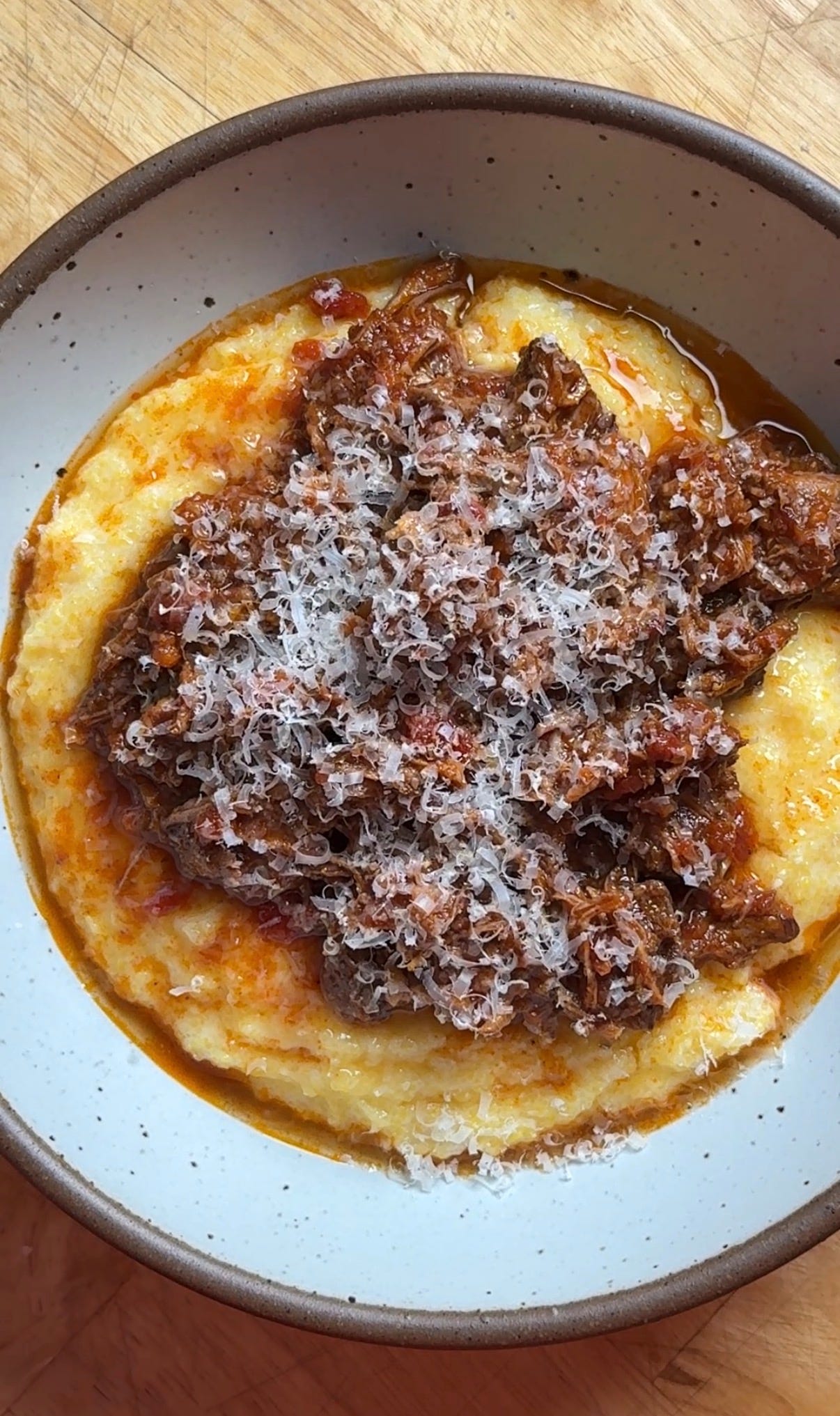
PORK AND BEEF RAGU RECIPE
Serves 6
Prep time: 20 minutes
Total time: 3 ½ hours
